




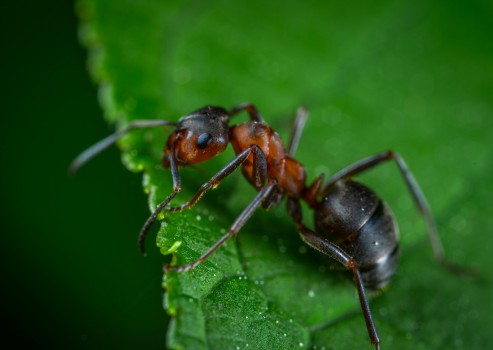
The intricate anatomical designs and behavioral patterns of ants, tigers, and monarch butterflies, along with the precise coordination of symbiotic relationships in nature, demonstrate purposeful engineering that sustains ecosystem balance and reveals the wisdom of an intelligent Creator.
Ant
Aerates and enriches soil, disperses seeds, and controls pest populations, promoting healthy ecosystems.
Anatomy: Ants have strong mandibles that allow them to dig intricate tunnel systems, which aerate and mix the soil, improving its fertility. Many species collect and transport seeds, some of which are left behind to germinate, aiding plant reproduction. Their cooperative colonies can overwhelm and control pest populations, while their small, segmented bodies and jointed legs make them agile movers through soil and vegetation. Ants' social organisation and specialised castes further enhance their ability to maintain ecosystem balance.
- Strong Mandibles: Ants have powerful mandibles (jaws) that they use to dig intricate tunnel networks underground. These tunnels aerate the soil by allowing air and water to penetrate deeper layers, which benefits root systems and microbial activity. The mandibles also allow ants to carry soil particles, seeds, and prey, supporting their role as ecosystem engineers.
- Jointed Legs and Compact Body: Ants' bodies are segmented with three main parts: head, thorax, and abdomen. Their jointed legs give them agility and strength relative to their size, enabling them to move through narrow tunnels and manipulate objects much larger than themselves. This strength and flexibility are crucial for digging, constructing nests, and relocating soil particles, all of which contribute to soil aeration.
- Petioles (Waist Segments): Many ant species have one or two petiole segments between the thorax and abdomen, creating a flexible "waist" that allows greater movement and control. This adaptability enables ants to maneuver through tunnels and narrow spaces while carrying items, making them efficient at transporting seeds and prey.
- Mouthparts for Seed Handling and Grooming: Ants possess specialised mouthparts designed for grasping, cutting, and carrying. Many ant species collect seeds and carry them to underground storage chambers, contributing to seed dispersal and plant diversity. Their grooming abilities also help control pest populations, as ants meticulously clean their bodies and nests, reducing disease spread within the colony.
- Chemical Communication (Pheromones): Ants use chemical signals, or pheromones, to communicate with colony members and coordinate tasks like foraging and defence. These pheromones are essential for organizing large-scale pest control operations and for guiding other ants to specific seeds or food sources, enhancing their efficiency in seed dispersal and pest management. (1)
Reflection - Ants are essential architects of healthy ecosystems by tunnelling through the ground, ants aerate the soil, allowing water and nutrients to penetrate more deeply and promoting root development. Their constant activity helps decompose organic matter and recycle nutrients that enrich the earth. Their anatomy and behaviour all demonstrating signs of pure design and purpose.
Tiger
Maintains prey populations, which influences vegetation and overall forest health in its habitat.
Anatomy: Tigers possess powerful jaws with long canines and sharp carnassial teeth designed to pierce and shear flesh. Their muscular bodies, retractable claws, and padded paws enable silent stalking and explosive bursts of speed to ambush prey. Striped fur provides camouflage in forested habitats, enhancing hunting efficiency. These anatomical adaptations make the tiger an apex predator, regulating herbivore numbers and sustaining the ecological balance of its ecosystem.
- Powerful Muscular Build: Tigers are highly muscular, especially in their forelimbs, which allows them to tackle and overpower large prey such as deer, wild boar, and antelope. This muscular build enables them to deliver powerful blows and maintain a strong grip on their prey, essential for hunting large herbivores that would otherwise overgraze vegetation.
- Sharp Retractable Claws: Tigers have sharp, retractable claws that they use to grip and immobilize prey. These claws help them capture and hold onto prey animals, making them effective hunters. Retractability also ensures that their claws stay sharp by minimizing wear, which is vital for their hunting efficiency.
- Strong Jaws and Sharp Teeth: Tigers possess large canines and strong jaw muscles that enable them to deliver a killing bite to the neck or throat of prey. This is essential for subduing and killing large animals quickly, making them efficient predators that can impact prey populations and prevent overgrazing.
- Keen Senses of Sight and Hearing: Tigers have excellent night vision, which allows them to hunt effectively in low light conditions when many prey animals are active. They also have highly developed hearing, helping them detect even slight movements in dense forests, which is crucial for stalking and ambushing prey.
- Camouflaged Fur (Stripes): A tiger's coat features distinctive stripes that help it blend into the forest and grassland environments, breaking up its outline and making it difficult for prey to spot them. This camouflage is essential for ambushing prey, as it allows them to get close before attacking, conserving energy and ensuring hunting success. (2)
Reflection - Tigers are critical to the environment because they serve as apex predators by maintaining balance of the entire ecosystems. By preying on herbivores such as deer, tigers prevent overgrazing and allow vegetation to regenerate, which in turn supports a wide range of species and preserves healthy forests. The tiger's role reveals an ecological intelligence embedded in its very form with its physical power, stealth, and instincts - these are not random traits but elements of a perfectly integrated design. Where tigers thrive, forests remain vibrant; where they vanish, ecosystems deteriorate. This delicate interdependence between predator, prey, and vegetation speaks to a purposeful order - manifests the wisdom of God who engineered it with precision, foresight, and intent.
Monarch Butterfly
Pollinates many wildflowers and serves as an indicator species for the health of ecosystems.
Anatomy: Monarch butterflies have long, coiled proboscises adapted for sipping nectar from deep within flowers, making them efficient pollinators. Their lightweight wings with distinctive orange and black patterns (3) enable long-distance migration, a rare trait among insects, allowing them to connect ecosystems across continents. Sensitive to environmental changes, their delicate exoskeletons and reliance on specific host plants (like milkweed) make them key indicators of ecosystem health and stability.
- Long, Coiled Proboscis: Monarchs have a specialised mouthpart called a proboscis, which they uncoil to drink nectar from flowers. This proboscis allows them to reach deep into various flowers, coming into contact with pollen. As they move from flower to flower, they transfer pollen, aiding in the pollination of wildflowers, which is essential for biodiversity in many ecosystems.
- Lightweight, Flexible Wings: Monarchs have large, lightweight wings with a high surface area that allows for long-distance migration. These wings make them agile fliers, enabling them to visit numerous flowers over large distances, which increases their role in pollinating diverse plant species along their migratory route. Their migratory patterns also make them an excellent indicator species, as they respond to changes in climate, habitat quality, and food availability across their route.
- Scaly Legs and Body for Pollen Transfer: The scales on monarchs' legs and body can pick up and transfer pollen grains as they feed on flowers. Monarchs contribute to the pollination of various plant species, especially milkweeds, which are crucial to their life cycle and are ecologically significant in their habitats.
- Bright Coloration as a Warning Signal: Monarch butterflies' distinct orange and black colouring serves as an aposematic (warning) signal to predators, indicating their toxicity due to milkweed ingestion. This bright coloration allows them to thrive in open, flower-rich habitats without significant predation, facilitating their role in pollination. Additionally, as indicator species, their population health and migration success reflect environmental factors that impact other species and overall ecosystem health.
Monarch Butterfly
An example of generational instinct
The monarch butterfly is an amazing example of generational design and instinct. In one season of the year, four generations of monarchs travel up to 3,000 miles from Mexico to Canada and back. It begins in early spring, when monarchs from the super generation (which overwintered in Mexico) begin the journey northward. They lay eggs in the southern United States, and these eggs hatch into the first generation. Then for the second and third generation, they continue moving northward covering around 500 miles each generation living for about 2-6 weeks as adults. Then in late summer the fourth generation is born, called "super generation." Unlike its predecessors, this generation doesn't reproduce immediately but instead embarks on the epic journey back to Mexico, where its great-grandparents once resided. This "super generation" lives for about eight months, completing the cycle and laying the groundwork for the next year's migration. (4)
Symbiotic Relationships
Symbiotic relationships involve mutually beneficial relationships between two different species. For example, certain flowers have specific colours, shapes, and nectar rewards to attract specific bees, butterflies, or birds, while the pollinators have specialised feeding structures suited to these floral features.
The flower's stigma gently brushes against the top of the hummingbird's head, ensuring that pollen is deposited as the bird reaches for its reward - the nectar deep within. The flower's structure is designed so that it would be nearly impossible for the bird to access the nectar without making direct, intentional contact with its reproductive parts, thereby facilitating effective pollination.
Evolutionists attempt to explain the symbiotic relationships in nature as, "the process by which two or more species influence each other's evolutionary pathways over time, often resulting in mutually beneficial adaptations or closely linked survival strategies." (5) Yet, this explanation attributes to animals a kind of awareness and creative intelligence that borders on science fiction. Are we really to believe that an animal somehow decides to change itself - altering its colour or developing a new feature, and then miraculously encoding that modification into its DNA? How could a creature with no foresight or plan anticipate that another species would also evolve in perfect synchrony to sustain the relationship? And how could this change be coordinated, communicated, and preserved through countless generations? If one pauses to think about this, realises how irrational this claim is - "the works of God plainly argue the vileness and perverseness of the atheist". (6)
Conclusion
From the microscopic tunnels of the ant to the three-thousand-mile journey of the Monarch, we see a world that is not merely "surviving," but one that is exquisitely choreographed. The tiger’s stealth, the butterfly’s generational memory, and the "locked-and-key" symbiosis between flower and bird all point to a singular truth: nature is a unified tapestry. These are not the disjointed products of blind mutations; they are the intentional expressions of a Creator whose wisdom encompasses the smallest insect and the vastest forest. When we see such perfect coordination between species that cannot speak to one another, we realize they are all following the script of the One who created them. God exists, and there is no doubt!
(Taken from the book: ‘God: There is No Doubt!’)
Footnotes
(1) B. Hölldobler and E. O. Wilson, The Ants. Harvard University Press, p. 240.
(2) M. Sunquist and F. Sunquist, Wild Cats of the World. University of Chicago Press.
(3) Their distinctive orange and black wing pattern is more than ornamental - it serves as a warning signal to predators that monarchs are toxic due to compounds absorbed from milkweed. The black pigmentation also aids in thermoregulation during flight, while the coloration helps individuals recognise their own species during migration and mating.
(4) F. A. Urquhart, and N. R. Urquhart, Autumnal Migration Routes of the Eastern Population of the Monarch Butterfly in North America to the Overwintering Site in the Neo-Volcanic Plateau of Mexico.
(5) J.N. Thompson, The Coevolutionary Process.
(6) Nick Spencer, Atheists: The Origin of the Species. Bloomsbury Publishing.
Leave a Review