




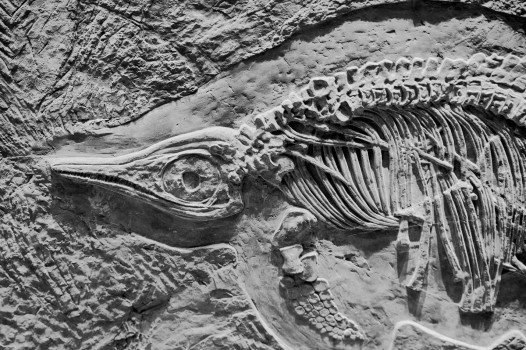
The fossil record, rather than confirming evolutionary theory's prediction of gradual transitions between species, reveals a pattern of stasis and sudden appearances of fully formed organisms, with the persistent absence of transitional forms exposing fundamental flaws in the claim that natural selection can account for the origin and diversity of life.
If the theory of evolution is correct and accurate, then we should naturally expect to find ample evidence in the fossil record. As animals are supposedly evolving and "incremental physical" changes are happening, we should find innumerable fossils demonstrating animals transitioning as they are evolving. However, not only do we find no fossil evidence despite there being millions of various types of animals, but we find the exact opposite: fossils of complete and fully formed animals.
We find long periods of stability and sudden appearances of fully formed species. This phenomenon, known as "stasis," contradicts the expectation of slow, incremental changes that the theory of evolution predicts. "Stasis" in the fossil record refers to a pattern where species appear to remain relatively unchanged over long periods of geological time, showing little or no significant morphological (physical) alteration for millions of years.
The absence of transitional fossils, the intermediate forms between major groups of species, directly challenges evolutionary theory. The Cambrian Explosion (541 million years ago) is a phenomenon in the fossil record which contradicts Evolution. Stephen C. Meyer highlights the Cambrian Explosion in his book, Darwin's Doubt: The Explosive Origin of Animal Life and the Case for Intelligent Design, that the fossil record prior to the Cambrian period shows little evidence of the complex life forms that suddenly appear during this explosion.
He argues that there is an absence of transitional forms leading to the Cambrian fauna, disproving the idea that these species evolved gradually. According to Meyer, this sudden burst of biological diversity is more consistent with the idea of an Intelligent Agent introducing complex organisms than with the slow and gradual changes posited by evolutionary theory. This rapid diversification of life forms, often referred to as "the biological big bang," is difficult to explain through the slow, gradual processes of natural selection. (1)
This lack of gradual, transitional fossils shows that evolution is not the mechanism through which species appeared. Stephen Jay Gould, the renowned palaeontologist at Harvard University and one of the most influential evolutionary biologists of the 20th century, admits, "The extreme rarity of transitional forms in the fossil record persists as the trade secret of palaeontology. The evolutionary trees that adorn our textbooks have data only at the tips and nodes of their branches; the rest is inference, however reasonable, not the evidence of fossils." (2)
In fact, Charles Darwin acknowledged this problem himself, calling the lack of transitional fossils in the record "the gravest objection which can be urged against my theory." (3) He admitted that the incomplete nature of the fossil record made it difficult to demonstrate the slow, incremental changes his theory proposed. It has been over 140 years since his death, and yet the fundamental problem remains: the fossil record still does not display the countless transitional forms that Darwin himself expected.
Instead of revealing a gradual, continuous chain of life, the evidence shows sudden appearances and fully formed species. Despite decades of searching, the predicted "missing links" remain elusive, leaving this core weakness unresolved and casting major doubt on the claim that evolution can account for the origin and diversity of life.
An objective and thorough study of nature reveals serious gaps, unanswered questions, and inconsistencies that expose the irrational and illogical basis of such claims. To illustrate this, let us pose a few simple yet rational questions using the example of the elephant.
Evolutionary biologists claim that modern elephants evolved from a group of extinct mammals known as proboscideans. (4) The earliest ancestor of elephants is believed to be a small, semi-aquatic mammal called Moeritherium, which lived around 37 million years ago. Moeritherium is allegedly smaller than modern elephants, and it resembled a hippopotamus with no long trunk and short legs. Over time, the descendants of Moeritherium are gradually meant to have evolved larger body sizes, tusks, and trunks, adapting to changing environmental conditions. (5)
The following is the hypothetical and alleged timeline for the animal with no trunk to evolve to an elephant with a trunk spanning tens of millions of years:
1. Moeritherium (37 million years ago): This early ancestor, which lived during the late Eocene epoch, had no trunk. Moeritherium was a small, semi-aquatic mammal, more like a tapir or hippo, with a short snout, and it did not yet have the distinctive long trunk we associate with modern elephants.
2. Palaeomastodon (30 million years ago): About 7 million years later, during the Oligocene epoch, the Palaeomastodon evolved with a slightly longer snout. It was not a full trunk, but it was a precursor to it. This early stage shows the gradual elongation of the face and nose.
3. Gomphotheres (20-10 million years ago): By the Miocene epoch, species like the Gomphotheres began to evolve a more recognisable trunk. This period marked a significant transition in the development of the trunk and tusks. Gomphotheres had a longer trunk.
4. Modern Elephants (5 million years ago to present): The fully developed trunk as we see it today in modern elephants (African and Asian species) likely emerged by the late Miocene or early Pliocene (around 5 million years ago). The trunk became a versatile organ used for feeding, drinking, social interaction, and more. (6)
"Missing Links" - Fake Fossils and Anthropology's Greatest Hoax
During the 20th century, several fossil discoveries - once celebrated as the definitive "proof" of human evolution - were later proven to be hoaxes, fabricated specimens that deceived both the scientific community and the public for decades. These forgeries were presented as conclusive evidence of "missing links" in the fossil record, showing transitional forms between major groups such as fish and amphibians, reptiles and birds, and apes and humans. These forgeries had a catastrophic impact on scientific thought, misleading researchers for nearly forty years and shaping evolutionary reconstructions - though all were later shown to be fakes. Two notable examples:
Piltdown Man (Eoanthropus dawsoni) - The Most Famous Hoax. Discovered by Charles Dawson in 1912 in Sussex, England. Was hailed as the "missing link" between ape and man, with a human-like skull and an ape-like jaw. In 1953, it was exposed as a fraud using advanced testing; it was revealed that the skull was a composite: the cranium of a modern human and the jaw of an orangutan, with filed-down teeth stained to appear ancient. (7)
Nebraska Man (Hesperopithecus haroldcookii) - A Tooth Becomes a "Man." Discovered in 1917 in Nebraska, USA, by Harold Cook. A single tooth was used to reconstruct an entire primitive human ancestor, dubbed "Nebraska Man." By 1927, the tooth was proven to belong not to a human, but to a pig. "Nebraska Man" became a textbook example of scientific error and overinterpretation based on scant evidence.
The fossil record contradicts evolutionary predictions. Instead of countless transitional forms, we find sudden appearances of fully formed organisms, long periods of stasis, and persistent gaps between species. The Cambrian Explosion and the absence of intermediate fossils expose a fundamental weakness in Darwin's theory. The evidence points not to gradual, blind processes, but to deliberate design by an intelligent Creator.
(Taken from the book: ‘God: There is No Doubt!’)
Footnotes
(1) Stephen Meyer, Darwin’s Doubt: The Explosive Origin of Animal Life and the Case for Intelligent Design. HarperOne
(2) Stephen Jay Gould, The Extreme Rarity of Transitional Forms in the Fossil Record Persists as the Trade Secret of Paleontology. Natural History
(3) Charles Darwin, On the Origin of Species
(4) Jeheskel Shoshani and Pascal Tassy, Advances in proboscidean taxonomy & classification, anatomy & physiology, and ecology & behaviour
(5) Jeheskel Shoshani and Pascal Tassy (editors), The Proboscidea: Evolution and Palaeoecology of Elephants and Their Relatives. Oxford University Press, p. 334.
(6) Ibid., p. 354.
(7) Reference: The official scientific paper that exposed the hoax was Weiner, J. S., Oakley, K. P., & Le Gros Clark, W. E. (1953). The Solution of the Piltdown Problem. Bulletin of the British Museum (Natural History). Also refer to Spencer, F., Piltdown: A Scientific Forgery (Oxford University Press) - a detailed scholarly look at how and why the fraud succeeded for decades.
Leave a Review