




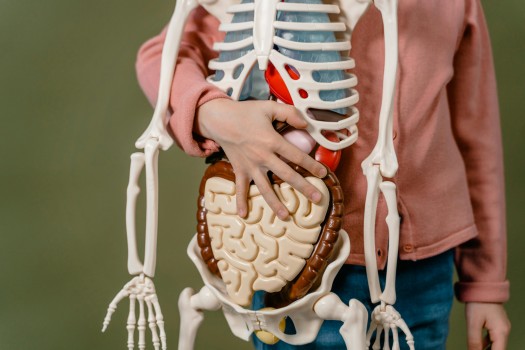
The intricate design and seamless coordination of biological organs, from the brain's computational power to the precision of human reproduction, reveal a level of complexity and purposeful engineering that points unmistakably to an intelligent Creator rather than random evolutionary processes.
Biological organs – functions
سَنُرِيهِمْ آيَاتِنَا فِي الْآفَاقِ وَفِي أَنفُسِهِمْ حَتَّىٰ يَتَبَيَّنَ لَهُمْ أَنَّهُ الْحَقُّ
"We shall show them Our signs in the horizons and within themselves until it becomes clear to them that this is the truth." (1)
Every organ in the body works in seamless, coordinated perfection. The heart pumps blood, the lungs oxygenate it, the brain directs responses, the digestive system breaks down food, and the endocrine system regulates metabolism through finely-tuned hormones. Each system is specialized yet interdependent—a masterpiece of biological design that points toward an intelligent Creator.
The Brain is arguably the most complex structure in existence, performing an estimated one quintillion (10^18) calculations per second using only about 20 watts of power—less than a light bulb. It contains over 80 billion neurons (2), each forming thousands of connections, creating trillions of synaptic links. Electrical impulses travel along nerve fibers at speeds up to 270 mph (3), relaying messages without delay. No human-made communication network even comes close to the brain’s sophistication.
The Eye is an engineering marvel with an effective resolution of several hundred megapixels, distinguishing around 10 million colors. It self-cleans, lubricates, and protects itself with tears containing antibacterial enzymes. The retina captures up to 15 images per second—over a million per day—and refreshes instantly (4). Charles Darwin himself admitted the seeming absurdity of such an organ evolving by chance:
"To suppose that the eye, with all its inimitable contrivances ... could have been formed by natural selection, seems, I freely confess, absurd in the highest possible degree." (5)
The Ear mastered wireless sound reception long before human technology. The cochlea contains about 15,000 hair cells, each tuned to specific frequencies, creating a detailed sound map for the brain to interpret. (6)
The Heart beats around 100,000 times per day—2.5 billion times in a lifetime—without stopping. It pumps about 1.5 gallons of blood per minute through 60,000 miles of vessels, enough to circle the Earth twice. (7)
Digestion works like a precision factory: food is tasted, crushed, moistened, and directed to the stomach, where millions of cells produce enzymes and acids to break it down. The stomach holds about 5 million such cells, the intestines 40 million, and the liver over 3.5 billion. These not only digest but also defend against diseases like cholera and dysentery. (8)
The Lungs fill over 300 million tiny alveoli with each breath—covering about 100 square yards if laid flat. Capillaries wrap around each air sac, exchanging oxygen and carbon dioxide with remarkable efficiency, processing over 7,000 liters of blood daily. (9)
DNA is the ultimate blueprint of life, storing vast information in a microscopic structure. It functions like advanced computer code, using just four nucleotide bases (A, T, G, C) to encode instructions for building proteins. Richard Dawkins called it "uncannily computer-like," (10) and Bill Gates said it is "far, far more advanced than any software we've ever created." (11) Francis Collins, who led the Human Genome Project, wrote:
"When you have for the first time in front of you this 3.1 billion-letter instruction book that conveys all kinds of information, and you realize it's about you, it is a moment of awe. It is a moment that brings you closer to God." (12)
Anthony Flew also acknowledged:
"What I think the DNA material has done is that it has shown ... that intelligence must have been involved in getting these extraordinarily diverse elements to work together." (13)
Reproduction – A Treasury of Signs
وَمِن كُلِّ شَيْءٍ خَلَقْنَا زَوْجَيْنِ لَعَلَّكُمْ تَذَكَّرُونَ
"And of everything We created pairs, so that you may be mindful." (14)
Across species—birds, fish, mammals—life is divided into male and female, each anatomically and physiologically designed to complement the other. This universal reproductive design reflects a unifying blueprint from one Creator.
During fertilization, sperm and egg each contribute 3 billion DNA base pairs, aligning perfectly to form a complete genome. The probability of such precise alignment by chance is practically zero. The male and female reproductive organs are anatomically and physiologically matched in form and function, coordinated even in arousal responses—clear evidence of intentional design.
Human cells contain 46 chromosomes, except sex cells (sperm and egg), which have 23 each. The sperm is uniquely designed with a tail for motility, guided by structures in the female reproductive tract. Sperm are stored in the testes at a temperature 2–4°C lower than body temperature—a precise adaptation for viability.
Atheists must ask: How could such a synchronized, interdependent system arise by chance? If reproduction evolved gradually, how did species survive while male and female systems were still incompatible? The harmony and precision point unmistakably to design.
Programmed Cell Death
After fertilization, stem cells multiply rapidly. At a critical stage, apoptosis (programmed cell death) sculpts the embryo—for example, separating fingers and toes from webbed structures. Who programmed this death process?
During pregnancy, the placenta allows nutrient and oxygen transfer without mixing maternal and fetal blood—a protective design. As birth approaches, the hormone relaxin loosens pelvic ligaments, the cervix softens and dilates, and the baby’s skull remains partially unfused with soft spots (fontanelles) to ease passage through the birth canal.
A mother’s breasts prepare to produce milk only after birth, perfectly timed to nourish the newborn. Each step—from conception to delivery to lactation—unfolds in precise, interdependent sequence, defying random chance.
Conclusion
From the digital code of DNA to the precision of the beating heart, human biology is not a collection of accidents, but a sanctuary of Divine signs. We carry within ourselves a level of technology that humbles the most advanced supercomputers and engineering feats of man. As the Qur’an suggests, these signs are placed within us so that the truth becomes clear. When we look at the seamless coordination required for a single breath or the miracle of a new life, we find that the body does not just function—it speaks. It testifies to a Creator whose knowledge is infinite and whose design is perfect. Indeed, God exists, and there is no doubt!
(Taken from the book: ‘God: There is No Doubt!’)
Footnotes
(1) Surah Fussilat 41:53.
(2) E. R. Kandel, Schwartz, J. H., & Jessell, T. M. Principles of Neural Science. McGraw-Hill Education.
(3) M. F. Bear, B. W. Connors and M. A. Paradiso, Neuroscience: Exploring the Brain. Wolters Kluwer
(4) R. L. De Valois, and K. K. De Valois, Spatial Vision. Oxford University Press.
(5) Charles Darwin, On the Origin of Species, Ch. 6, “Difficulties on Theory,” p. 186.
(6) E. R. Kandel, J. H. Schwartz and T. M. Jessell, Principles of Neural Science. McGraw-Hill.
(7) R. E. Klabunde, Cardiovascular Physiology Concepts. Lippincott Williams & Wilkins.
(8) W. F. Boron and E. L. Boulpaep, Medical Physiology. Elsevier, p. 912.
(9) E. R. Weibel, The Pathway for Oxygen: Structure and Function in the Mammalian Respiratory System. Harvard University Press.
(10) Richard Dawkins, River Out of Eden: A Darwinian View of Life.
(11) Bill Gates, The Road Ahead, p. 188.
(12) Francis S. Collins, The Language of God: A Scientist Presents Evidence for Belief. Free Press, p. 3.
(13) Anthony Flew and Roy Abraham Varghese, There Is a God: How the World's Most Notorious Atheist Changed His Mind. HarperOne, p. 75.
(14) Surah adh-Dhariyat 51:49.
Leave a Review