




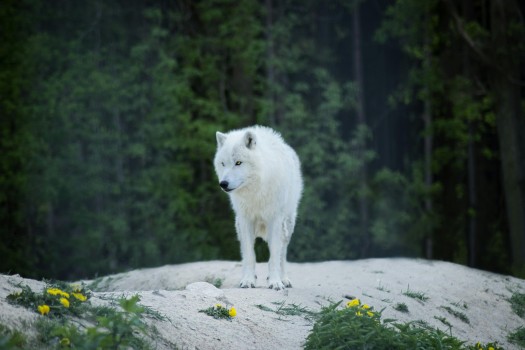
The intricate anatomical designs of wolves, vultures, and beavers reveal how each species is purposefully equipped to fulfill critical ecological roles, demonstrating that the harmony between form, function, and environmental impact points to intelligent design rather than random chance.
Wolf
Regulates prey populations, like deer and elk, which prevents overgrazing and maintains plant diversity.
Anatomy: Wolves have powerful jaws with sharp carnassial teeth designed to tear flesh, supported by strong jaw muscles that allow them to bring down large prey. Their lean, muscular bodies and long legs enable endurance hunting over vast territories, while acute senses of smell and hearing help track animals. This anatomy equips wolves to control herbivore populations effectively, indirectly protecting vegetation and overall ecosystem balance.
- Powerful Muscles and Limbs: Wolves have strong, muscular legs that allow them to run at high speeds (up to 40 mph) for short bursts and endure long distances while tracking prey. This endurance and speed enable them to pursue large animals, like deer and elk, through rough terrains and across vast areas, making them effective hunters capable of impacting prey populations.
- Sharp Teeth and Strong Jaws: Wolves have 42 teeth, including long canine teeth and carnassials (sharp, scissor-like molars), which are specially adapted for tearing and cutting flesh. Their jaw muscles are powerful, allowing them to deliver a strong bite force to take down and efficiently consume large prey. This dental structure supports their role as apex predators, helping control populations of large herbivores.
- Senses of Smell and Hearing: Wolves have an acute sense of smell - estimated to be 100 times stronger than that of humans - and highly developed hearing. These senses allow them to detect prey from miles away, aiding in tracking and coordinating group hunts, which are crucial for managing populations of large and agile animals like elk.
- Pack Structure and Social Coordination: Wolves are social animals that hunt in packs, allowing them to take down prey much larger than a single wolf could manage alone. Each pack member has a role, and their cooperative hunting strategy increases hunting success. This social structure enables wolves to control populations of herbivores that would otherwise contribute to overgrazing, helping to preserve plant diversity. (1)
Reflection - When wolves were reintroduced to Yellowstone National Park, US, in 1995 after a seventy-year absence, the ecosystem underwent a remarkable change. By preying on overabundant elk, wolves reduced overgrazing, allowing vegetation such as willows to recover. This regrowth stabilised riverbanks, leading to clearer streams and the return of beavers, birds, and fish. As prey behaviour changed - avoiding certain areas - plants and trees flourished once more, attracting insects and smaller mammals. What began as the return of a single species sparked a chain reaction of restoration, demonstrating how one well-designed predator can revive the balance and health of an entire ecosystem.
Vulture
Scavenges carcasses, which helps prevent disease spread by quickly disposing of dead animals.
Anatomy: Vultures have bald heads and necks that prevent feathers from becoming soiled with blood while feeding, reducing infection risk. Their strong, hooked beaks are adapted to tear through tough hides, and their highly acidic stomachs can safely digest decaying flesh and kill dangerous pathogens. With keen eyesight and broad wings for soaring long distances, vultures are perfectly equipped to locate and clean up carrion, protecting ecosystems from disease outbreaks.
- Strong, Hooked Beak: Vultures have powerful, hooked beaks that are specifically adapted to tear through tough skin, muscle, and other tissues of carcasses. This beak structure allows them to access meat on even larger animals efficiently and quickly, breaking down remains that would otherwise attract pathogens.
- Highly Acidic Stomach: Vultures possess one of the most acidic stomachs in the animal kingdom, with stomach acid strong enough to kill many harmful bacteria and pathogens found in rotting carcasses, such as anthrax, botulism, and rabies. This adaptation allows them to consume decomposing animals without getting sick and prevents the spread of disease into the environment.
- Featherless Head and Neck: Most vulture species have bare skin on their heads and necks, an adaptation that helps them stay clean when feeding on carcasses. By reducing the amount of feathers in contact with blood and decaying matter, they can avoid contamination and minimise the build-up of bacteria on their bodies.
- Keen Eyesight: Vultures have excellent eyesight, allowing them to spot carcasses from high in the sky, often over several miles. This sharp vision helps them locate food sources quickly, contributing to their efficiency as scavengers and enabling them to dispose of dead animals before pathogens spread.
- Long, Broad Wings: Vultures have large, broad wings adapted for soaring at great heights with minimal energy expenditure. This allows them to cover vast distances in search of carrion, further enhancing their role in ecosystem clean up. (2)
Reflection - The vulture is far more than a scavenger; it is nature's sanitation system, designed to protect life through death. Every part of its anatomy serves a precise hygienic function. Its bald head and neck prevent the build-up of bacteria while feeding on carcasses, its hooked beak tears through hide and tissue with surgical precision, and its highly acidic stomach neutralises deadly pathogens such as anthrax and rabies. What would otherwise spread disease and decay is swiftly transformed into renewal through this remarkable design. Its broad wings allow it to soar effortlessly across vast distances, scanning the ground below with extraordinary vision to locate the remains of the dead before they can become a source of infection. This ensures that disease does not take hold and that the cycle of life continues unbroken. The vulture does not merely consume, it purifies. Such refinement of purpose cannot be reduced to chance. Every aspect of the vulture's anatomy and behaviour functions toward a greater good, maintaining the delicate health of the ecosystem. Did it evolve itself to fulfil this purpose?
Beaver
Constructs dams that create wetlands, supporting biodiversity by providing habitat for many species.
Anatomy: Beavers have strong, chisel-like incisors that grow continuously, perfectly adapted for gnawing through wood to cut down trees and branches for dam building. Their powerful jaws and muscular bodies allow them to transport heavy logs, while their broad, flat tails provide balance on land and propulsion in water. Webbed hind feet make them efficient swimmers, enabling them to construct and maintain dams and lodges that transform landscapes into rich wetland ecosystems.
- Strong Incisors: Beavers have large, continuously growing incisors with hard, orange enamel on the front surface and softer dentin on the back. This unique structure sharpens their teeth as they gnaw, enabling them to cut down trees and branches with ease. These powerful teeth are essential for gathering the wood and building materials needed for dam construction.
- Robust Jaw Muscles: Beavers have exceptionally strong jaw muscles that allow them to exert the necessary force to gnaw through wood efficiently. Their jaws are designed to withstand the stress of constant chewing, making them effective at modifying their environment by felling trees and manipulating large branches.
- Webbed Hind Feet: Beavers' hind feet are webbed, which makes them strong swimmers. This adaptation is crucial for their ability to move materials and navigate aquatic environments where they build their dams and lodges. Their swimming ability allows them to carry heavy branches and other building materials across water to the dam site.
- Large, Flat Tail: The broad, flat tail of the beaver serves multiple purposes. It acts as a rudder while swimming, provides balance while gnawing on trees, and can be used to slap the water as an alarm signal to warn other beavers of danger. The tail's versatility supports beavers in their roles as builders and aquatic engineers.
- Waterproof Fur: Beavers have dense, waterproof fur that insulates them in cold water. This design allows them to work in waterlogged environments comfortably and spend extended periods in the water to gather materials and build their structures without suffering from exposure. (3)
Reflection - The beaver is far more than a builder - it is an ecological engineer, designed to transform barren landscapes into thriving wetlands. Every part of its anatomy serves this purpose. Its ever-growing incisors, strengthened by iron-rich enamel, cut cleanly through wood, while its powerful jaws and muscular body enable it to transport heavy logs with ease. Its broad, flat tail provides balance on land and functions as both a rudder and a warning signal in water, while its webbed feet and waterproof fur make it perfectly designed for an aquatic lifestyle. Through these traits, the beaver performs one of nature's most extraordinary feats of environmental design - the construction of dams and lodges that reshape entire ecosystems. By slowing water flow, its dams create wetlands that become sanctuaries for fish, birds and countless other species. These wetlands filter water, prevent floods, and sustain biodiversity, demonstrating that the beaver's instinctive engineering achieves what even advanced human planning often struggles to accomplish: stable, self-renewing ecosystems. Can such harmony between anatomy, instinct, and ecological impact be attributed to mere accident?
(Taken from the book: ‘God: There is No Doubt!’)
Footnotes
(1) Mech, L. D., & Boitani, L. Wolves: Behaviour, Ecology, and Conservation. University of Chicago Press.
(2) D. C. Houston, Vultures and Condors. Facts on File.
(3) Dietland Müller-Schwarze and Lixing Sun, The Beaver: Natural History of a Wetlands Engineer. Cornell University Press, p. 45.
Leave a Review