




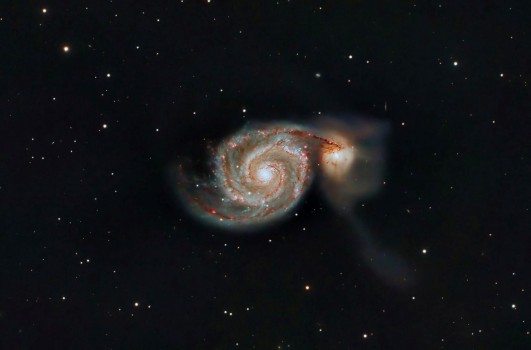
Modern cosmology's confirmation of the universe's beginning through the Big Bang theory, Hubble's Law, and cosmic microwave background radiation forces a logical conclusion: that which begins to exist requires a cause, and since the universe began to exist, it demands a transcendent Creator who exists beyond space, time, and matter.
"Today, that very same weapon - science - which was supposed to have brought religion to an ignominious end, has at last been turned against the scoffers and atheists, and we are, at the moment, witnessing the same momentous revolution in thinking as took place in the seventh century with the advent of the Prophet of Islam. God himself has razed the walls of atheism to the ground, and science stands ready to bear out His word." (1)
You are about to examine scientific evidence that demonstrates, with clarity and reason, that the universe is the deliberate creation of the one Creator, meticulously designed by the one Designer, and continuously sustained by the one Sustainer.
Approach this material with a critical and analytical mindset. By remaining objective and free from preconceptions, you will be able to assess the evidence on its own merit. Ultimately, there are only three rational possibilities to consider:
- The universe has no Creator and came into existence through unguided, random processes.
- There are multiple gods who share in creation and control.
- There is one God - the sole Creator, Designer, and Sustainer of all that exists.
As you review the evidence, weigh these three possibilities carefully to determine which offers the most coherent, logical, and scientifically consistent explanation that leads to true certainty.
Science as a Tool - Boundaries of Scientific Inquiry
Before proceeding, it is important to clarify what science can, and cannot, be used for. With the tools of science, we can describe in detail how water evaporates from the sea, condenses into clouds, and falls back as rain upon the land. Yet all of this remains a description of what happens, not an ultimate explanation. Science can map the processes, but it does not tell us how these processes came to be, or why the laws that govern them exist in the first place - this lies beyond the scope of scientific description. The truth is that it is from observing such natural phenomena that scientists derive their laws, not the other way around. Science organises, measures, and formulates patterns from what is already there, but it does not answer why those patterns exist.
When we claim that by uncovering the laws of nature, we have solved the mystery of the universe, we deceive ourselves. To equate the discovery of a mechanism with the explanation of existence itself is like taking a link from the middle of a chain and declaring it the end. Nature does not explain itself. The universe and its laws cannot be their own cause. They point beyond themselves to a higher reality, for the very order and intelligibility (2) that science uncovers requires an explanation that science, by its very method, cannot provide. Science is a tool, powerful for describing the how of processes, but ultimately silent on the why of existence. Erwin Schrödinger, physicist and Nobel laureate, best known for founding quantum wave mechanics, said,
The scientific picture of the world around me is very deficient. It gives me a lot of factual information, puts all our experience in a magnificently consistent order, but is ghastly silent about all that is really near to our heart, that really matters to us. It cannot tell a word about the sensation of red and blue, bitter and sweet, feelings of delight and sorrow. It knows nothing of beauty and ugliness, good or bad, God and eternity. Science sometimes pretends to answer questions in these domains, but the answers are very often so silly that we are not inclined to take them seriously. (3)
If nature cannot explain itself, then its very existence demands an explanation beyond itself. The universe and its laws cannot be the cause of their own being; they are contingent, dependent, and finely ordered. These very contingency points decisively point to One who is external to nature, who brought it into existence and sustains it.
The Disruption: Scientific Evidence of a Beginning
For much of the early 20th century, the "steady state" theory, which held an eternal, unchanging universe, dominated the views among Western scientists. According to this theory, the universe existed in a constant state, with no beginning or end. The appeal of this idea was that it eliminated the need for a cause or Creator, as philosopher Bertrand Russell famously stated, "The universe is just there, and that's all." (4) If the universe had no beginning, then it did not need an explanation for its existence. However, several key discoveries in the 20th century would fundamentally shatter this understanding of the cosmos.
In 1922, physicist Alexander Friedmann produced computations showing that the structure of the universe was not static and that even a tiny impulse might be sufficient to cause the whole structure to expand or contract according to Einstein's "Theory of General Relativity." George Lemaitre was the first to recognise the implications of what Friedmann concluded. Lemaitre formulated that the universe had begun in a cataclysmic explosion of a small, primeval atom. He also proposed that the amount of cosmic radiation is the leftover remnants of the initial "explosion." The theoretical musings of these two scientists did not attract much attention and probably would have gone ignored except for new observational evidence that rocked the scientific world in 1929. That year, American astronomer Edwin Hubble made one of the most important discoveries in the history of astronomy. He discovered that galaxies were moving away from us at speeds directly proportional to their distance from us and from each other. A universe where everything constantly moves away from everything else implies a constantly expanding universe. Stephen Hawking writes, "The expansion of the universe was one of the most important intellectual discoveries of the 20th century, or of any century." (5)
Since the universe is constantly expanding, were we to rewind a film of its history, then necessarily we would find the entire universe was in a joint state, referred to by some as the "primordial atom." Many scientists and philosophers resisted the idea of a beginning to the universe because of the many questions that it raised - primarily what or who caused it. However, with Penzias and Wilson's discovery of microwave radiation emanating from all directions, possessing the same physical characteristics - namely, petrified light which came from a huge explosion during the first seconds after the birth of the universe - left little doubt about the fact that the universe had a beginning. We are told that at the start of the Big Bang, the universe grew incredibly, expanding from a subatomic size to billions of miles within the first minute.
Cosmologists now unanimously agree on the following key evidence supporting the Big Bang theory:
1. Expansion of the Universe - now referred to as Hubble's Law. The discovery that galaxies are moving away from us with their speed proportional to their distance. This also showed that the universe is expanding and has historically been concentrated at a single point. Additionally, the light from distant galaxies is shifted towards the red end of the spectrum, indicating they are moving away from us.
2. Cosmic Microwave Background Radiation (CMBR)
3. Abundance of Light Elements - The Big Bang theory predicts the formation of light elements like hydrogen, helium, and small amounts of lithium during the first few minutes after the universe began. Observations of the universe's composition have matched these predictions.
Implications of a Beginning
The implications of these discoveries are profound. The realisation that the universe had a definite beginning has fundamentally shaken the scientific foundations of the atheistic worldview. Robert Wilson, recipient of the Nobel Prize in Physics for the discovery of the Cosmic Microwave Background Radiation (CMBR), the second of the aforementioned evidence, said, "If the universe had a beginning, then we cannot avoid the question of creation." (6) This discovery inevitably raises a critical question: "Who caused the universe to come into existence?" The principle of causality, a cornerstone of scientific reasoning, holds that every effect must have a cause. Therefore, if the universe began to exist, it must have been brought into being by something or someone beyond itself. This reasoning is central to the Kalam Cosmological Argument, which states:
- Everything that begins to exist has a cause.
- The universe began to exist.
- Therefore, the universe has a cause.
This "cause" must transcend space, time, and matter, since these very dimensions came into existence at the moment of the Big Bang.
The Big Bang has compelled atheists and naturalist philosophers to confront the implications of a cosmic beginning. Rather than accept the obvious facts, their response has been to propose alternative explanations, such as multiverse hypotheses or quantum fluctuation models, just so they can avoid the conclusion of God. However, none of these theories has any scientific grounding and lack evidence that the Big Bang theory possesses. If the universe was created by a conscious, purposeful Being, then it follows that humans and the universe itself have meaning and purpose.
(Taken from the book: ‘God: There is No Doubt!’)
(1) Waheedudeen Khan, God Arises.
(2) Albert Einstein said, “The most incomprehensible thing about the universe is that it is comprehensible.” Physics and Reality. Journal of the Franklin Institute.
(3) E. Schrödinger, Nature and the Greeks. Cambridge University Press, p. 94.
(4) Betrand Russell, The Existence of God. BBC Radio Debate, January 1948.
(5) Stephen Hawking, A Brief History of Time: From the Big Bang to Black Holes.
(6) Michel-Yves Bolloré and Olivier Bonnassies, God, the Science, the Evidence: The Dawn of a Revolution.
Leave a Review